
Last updated November 4, 2026
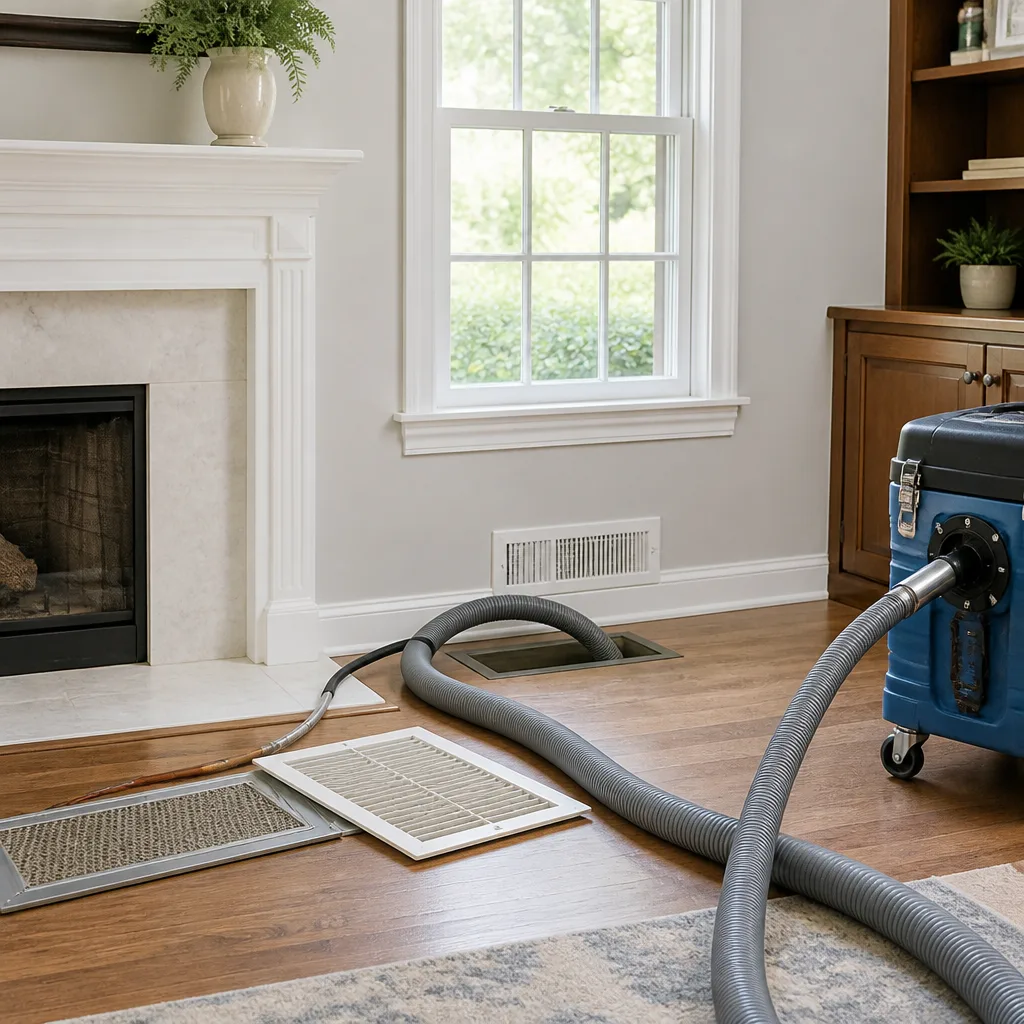 Whole-home duct cleaning
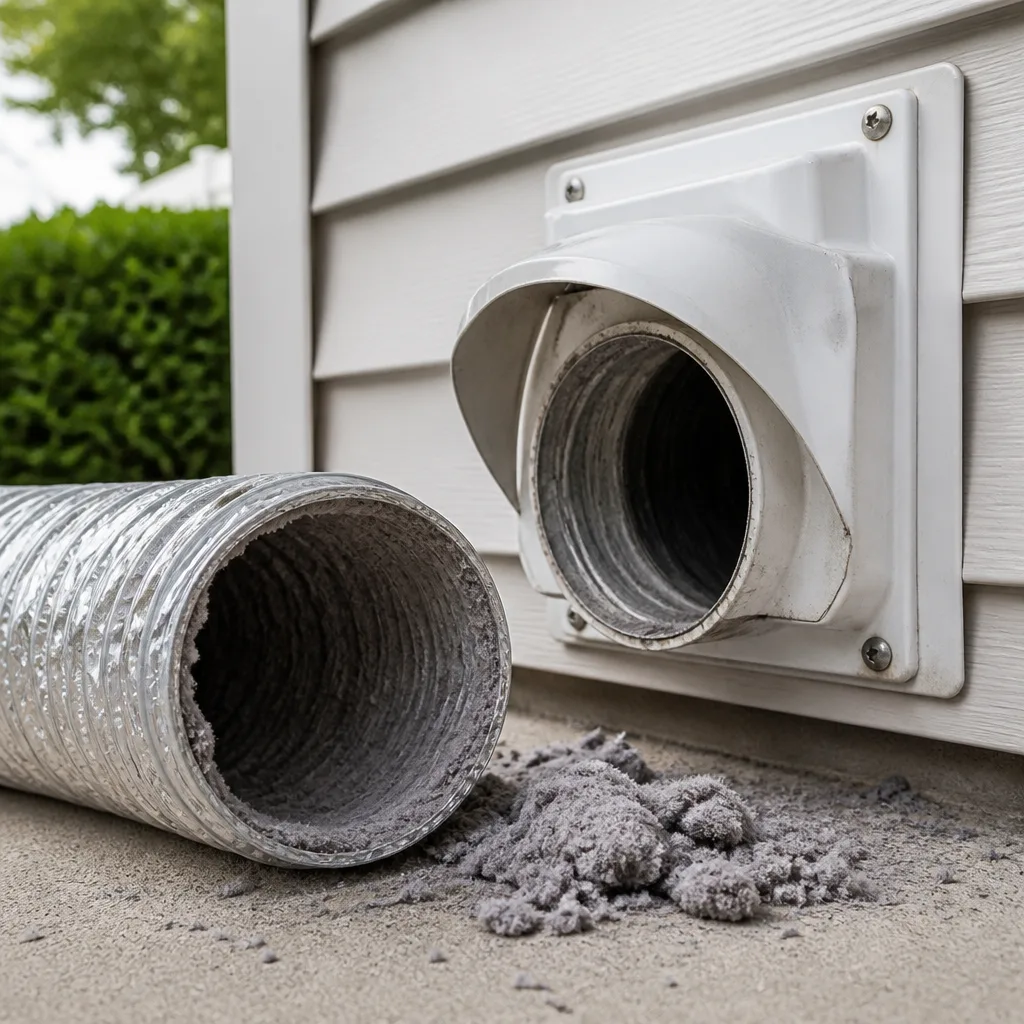 Dryer vent cleaning
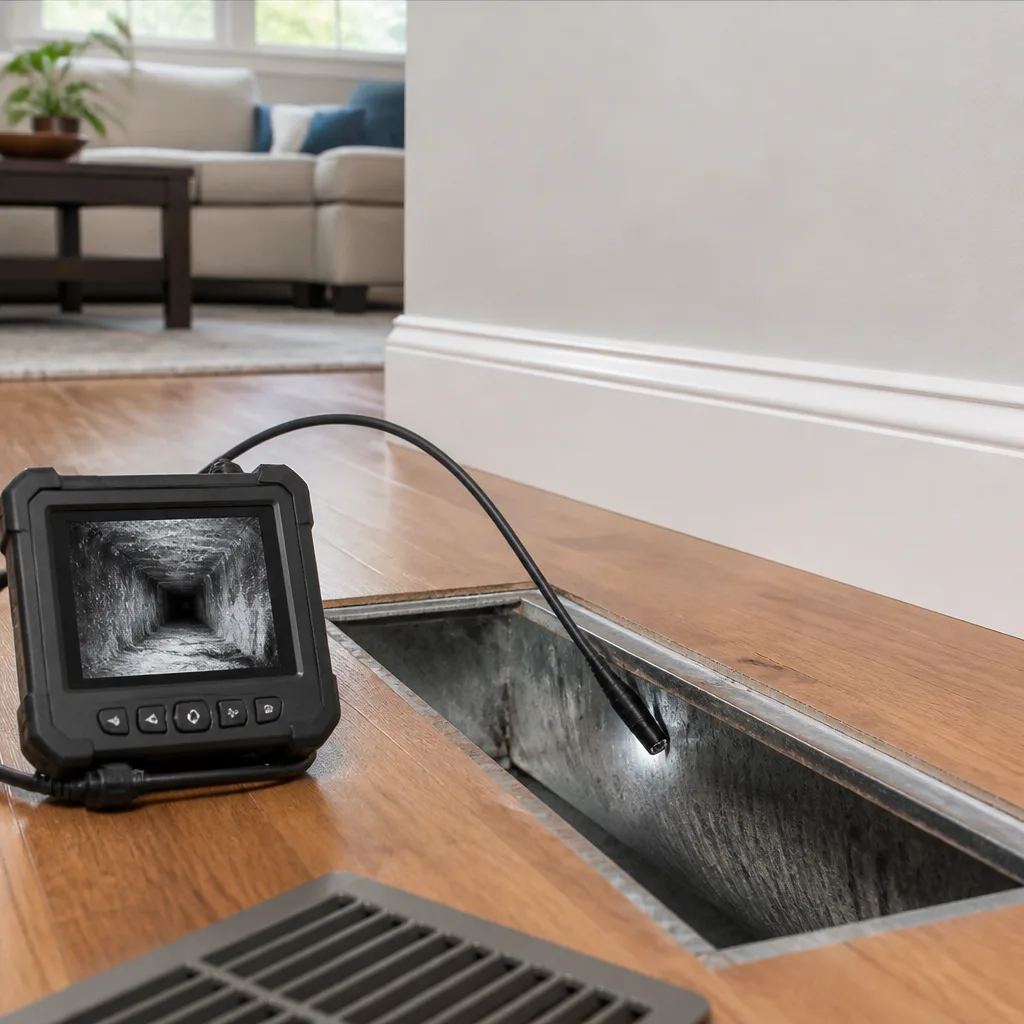 Camera inspection
 Sanitizing & deodorizing
Whole-system duct and dryer vent check with before-and-after photos - you see exactly what came out of your vents
That "$99 whole-house special" is a bait ad - the real number appears once they are in your hallway, or the "clean" is a shop-vac at the register. We photograph the inside of your ducts before and after instead.
DIY vs Professional Air Duct Cleaning: The Rancho Bernardo Homeowner’s Decision Guide
Here’s a number that stops most Rancho Bernardo homeowners mid-scroll: a $300 consumer duct cleaning kit generates roughly 1/15th the suction of a professional truck-mount system. That’s not a marketing talking point. It’s physics. You can move dust around inside your ducts with a drill-powered brush and a shop vac. What you cannot do is extract the debris compacted against duct walls from years of San Diego County air moving through them at 400 cubic feet per minute. This guide gives you the straight answer on what DIY can and cannot do, where the real risks hide, and when calling a professional for Air Duct Cleaning actually saves you money.
Quick Answer
DIY air duct cleaning is appropriate for register-level maintenance: cleaning vent covers, replacing filters, and brushing the first few inches of accessible ductwork. Professional cleaning is required for anything inside the trunk line and branch ducts, where negative-pressure extraction with HEPA filtration is the only method that removes compacted debris rather than loosening it into your living space. In Rancho Bernardo, most homes with 10- to 20-year-old HVAC systems fall into the professional category.
Styles & brands we work with
- Whole-home duct cleaning
- Dryer vent cleaning
- Camera inspection
- Sanitizing & deodorizing
Table of Contents
- What DIY Duct Maintenance Legitimately Accomplishes
- The Physics of Duct Cleaning: Why Suction Math Matters
- When DIY Duct Cleaning Causes Damage
- How to Use DIY Inspection to Decide If You Even Need Cleaning
- The Real Cost Comparison: DIY Gone Wrong vs. Professional Upfront
- Rancho Bernardo-Specific Factors That Change the Equation
- What Professional Equipment Actually Does Differently
- Common Mistakes to Avoid
What DIY Duct Maintenance Legitimately Accomplishes
Let’s be fair about what a homeowner with basic tools can do. DIY duct work is not a scam, and it is not worthless. It’s a specific category of maintenance that addresses the visible surfaces you interact with daily. What it doesn’t do is anything you can’t see.
Here’s what we tell Rancho Bernardo homeowners they can handle themselves, right now, with tools they either own or can buy for under $50:
- Register and grille cleaning. Remove wall, floor, or ceiling registers. Wash them in warm soapy water. Wipe the first 2 to 3 inches of visible duct interior with a damp microfiber cloth. This clears the dust you see and the dust that triggers visible allergies when it blows back into the room.
- Filter replacement discipline. A clean filter is the single highest-leverage DIY action. In Rancho Bernardo, where we get Santa Ana wind events pushing fine dust into homes, checking filters every 30 to 60 days matters more than in coastal neighborhoods. Run a MERV 8 to MERV 11 filter, and swap it before it browns over.
- Dryer vent exterior brushing. If your dryer vent run is short (under 10 feet, straight), a $25 brush kit from any hardware store can pull a surprising amount of lint from the first few feet. This is genuine fire-risk reduction, and we cover it in more depth on our dryer vent cleaning page.
- Return-air register vacuuming. The return side of your system pulls air in, so those registers accumulate a mat of dust on their face. Vacuuming them monthly keeps your filter from clogging prematurely.
- Visual inspection. Remove a few registers, point a flashlight in, and look. Is the metal shiny? Is there gray fuzz lining the walls? Do you see rodent droppings or construction debris? This is not cleaning. It’s diagnostics, and it’s the most useful DIY skill there is.
The honest summary: DIY addresses the surfaces you touch and the filters you replace. Anything deeper than 3 inches into the duct system is typically beyond what hand tools and consumer vacuums can meaningfully clean. That’s not a lack of effort. It’s a limitation of the equipment category.
The Physics of Duct Cleaning: Why Suction Math Matters
Duct cleaning works on one principle: negative pressure. A professional system seals the duct run and applies vacuum force strong enough to pull debris off the duct walls, not just capture what’s already loose and floating. Think of it as the difference between sweeping a floor and using a properly sealed vacuum with a beater bar.
Here’s the math that matters. A consumer shop vac generates between 80 and 120 cubic feet per minute (CFM) of airflow. It feels strong at the nozzle, and it’s fine for picking up sawdust or water. A professional truck-mount system, the kind we run on air duct cleaning jobs throughout Rancho Bernardo, generates 2,000 to 5,000 CFM. That’s not 15% more suction. That’s 15 to 40 times more airflow, delivered through a system designed to maintain negative pressure across long runs of duct.
Why does this matter mechanically? Because debris inside a duct is not sitting there as loose dust you can vacuum up. It accumulates over years, gets coated with humidity-driven residue, and compacts against the duct walls. Loosening that debris requires mechanical agitation. Extracting it without sending it into your living room requires containment.
Professional systems combine three things:
- Rotary brush agitation. A motorized brush physically breaks the mechanical bond between debris and the duct wall surface. This is the step most DIY attempts skip entirely.
- High-CFM negative pressure. The vacuum side of the system pulls at a rate that captures the dislodged debris before it can settle elsewhere in the duct run or escape into your home.
- Containment protocols. Abatement Technologies negative-air equipment is what we use on our jobs. It creates directional airflow so any dislodged particulates exit the system through HEPA filtration, not through your living room registers.
The physics answer to “can I just use a shop vac?” is no. A shop vac blows and sucks at the same location, stirring debris into the air of your home while capturing only a fraction of it. It’s the equivalent of dusting a shelf by waving a towel at it and hoping the dust goes somewhere else.
When DIY Duct Cleaning Causes Damage
Now for the uncomfortable part: some DIY attempts don’t just fail to clean. They cause real damage that costs more to repair than the professional cleaning would have cost upfront. We’ve seen this in Rancho Bernardo homes, and we’ve repaired the results.
Here are the specific scenarios where DIY efforts break things:
- Older flex duct systems. Homes built in the 1980s and 1990s, common in the older Rancho Bernardo developments, often have flex duct runs. Flex duct is a thin plastic or foil tube wrapped around a wire coil. It’s durable under normal airflow, but it’s not built to handle aggressive brush insertion. A drill-powered brush in a flex duct can tear the inner liner, which then leaks conditioned air into the attic. You won’t know it’s happened until your energy bill spikes or a room stops cooling.
- Improperly supported trunk lines. The main trunk line running through your attic or crawlspace carries the full air volume of your system. In some older Rancho Bernardo homes, those trunk lines are supported by straps that have loosened over decades of thermal cycling. Inserting a stiff brush and applying force can shift the duct off its hangers. Once an unsupported section sags, it collects condensation and debris, which accelerates mold growth and further leaks.
- Closed-cell spray foam around duct joints. Some Rancho Bernardo homes have had energy-efficiency retrofits where spray foam was applied around duct connections. If you break that seal during a DIY cleaning attempt, you create an air leak that bypasses your filter entirely. The duct will pull unfiltered attic air into your home and push conditioned air out of the system.
- Old metal duct with sharp internal edges. Sheet metal ducts from original construction can have internal screws or sharp seams. A consumer brush with a fabric or low-quality bristle head can catch on those edges and either tear the brush head off inside the duct or, worse, separate a duct joint.
The common factor here is that the homeowner cannot see the condition of the duct interior before inserting something into it. We run a camera inspection before every air duct repair in Rancho Bernardo precisely because the duct wall tells us what it can tolerate. Guessing with a flexible brush is how $300 of DIY becomes a $1,800 repair.
How to Use DIY Inspection to Decide If You Even Need Cleaning
Here’s the practical part. You don’t need to guess whether your ducts are dirty. You can use a few ten-dollar tools and 45 minutes to gather real evidence. Then you can make a decision based on what you find, not on a sales pitch or a generic maintenance schedule. For more guides & resources, see our blog.
Follow these steps:
- Remove three registers: one in the master bedroom, one in the main living area, and one upstairs if you have a second floor. These three locations give you a representative sample of the system. The register farthest from the air handler typically shows the worst accumulation.
- Use a flashlight and your phone camera. Point the light into the duct opening and take a photo. Your phone camera, especially with flash, will reveal interior conditions that are hard to judge with the naked eye. You’re looking for: gray or tan fuzz matted on the duct walls, visible debris piles on the duct floor, dark staining that suggests moisture exposure, or any signs of rodent activity (droppings, nesting material).
- Check the return-air side. The return side pulls air into the system, so it accumulates dust differently than supply ducts. Remove the return register (usually a larger grille in a hallway or wall) and look inside. A visible dust mat on the return duct walls is normal after a few years. A thick, felt-like accumulation is not.
- Check the inside of your filter slot. Slide the filter out and look at the surface behind it. If you see dust accumulated on the interior side of the filter slot, that’s a sign that unfiltered air has been bypassing the filter, which means those particles are already in your ducts and likely in your blower and evaporator coil.
- Record what you find. If the duct walls are shiny metal with only light dust, you probably don’t need professional cleaning yet. If you can scrape debris off the duct walls with a plastic spoon, those walls need professional equipment to clean properly.
This inspection costs you nothing and gives you an evidence base. When you call any company, including us, you’ll already know whether the recommendation matches what you observed.
The Real Cost Comparison: DIY Gone Wrong vs. Professional Upfront
Let’s put numbers on this, because in Rancho Bernardo the cost question is the one every homeowner actually wants answered. Here’s an honest comparison, based on the work we’ve done and the repairs we’ve made in this market.
DIY Cost Baseline
- Consumer drill-powered brush kit: $25 to $60
- Shop vac (if you don’t own one): $80 to $150
- Replacement filters for after your DIY attempt: $15 to $45
- Time invested: 2 to 4 hours
- Typical total: $120 to $255
Professional Cleaning Baseline (Rancho Bernardo Market)
- Whole-home air duct cleaning, typical 2,000 to 3,000 square foot home: $450 to $750
- Includes trunk line, branch ducts, and return side
- Includes visual camera inspection of duct condition
- Typical time on site: 3 to 5 hours with two-person crew
- Typical total: $450 to $750
DIY Gone Wrong: Real Repair Costs We’ve Seen
- Torn flex duct replacement: $250 to $500 per run (most homes have 8 to 15 runs)
- Broken duct joint re-sealing: $150 to $350 per joint
- Damaged spray foam seal around duct connection: $120 to $300 per connection
- Loose trunk line re-supporting and re-sealing: $400 to $900
- Total system damage from an aggressive DIY attempt: $800 to $2,800+
The asymmetry is clear. When DIY goes right, you save $250 to $500. When DIY goes wrong, you spend $800 to $2,800 on repairs and you still haven’t cleaned the ducts. The hidden cost that doesn’t show up in any chart is the repair itself: every torn duct liner or broken seal means unfiltered air entering your system, which then coats your evaporator coil and blower wheel with the debris you were trying to remove in the first place.
Our position is not that DIY is always the wrong choice. It’s that DIY is right for the specific tasks we listed earlier and wrong for anything inside the duct runs. The inspection steps above tell you which category you’re in.
Rancho Bernardo-Specific Factors That Change the Equation
Rancho Bernardo is not a generic Southern California suburb when it comes to HVAC and duct conditions. Several local factors change the DIY calculus here in ways that a national-tier guide won’t tell you about.
Santa Ana wind events and fine particulate load. Rancho Bernardo sits inland from the coast, and when the Santa Anas blow, they push desert-derived fine dust through the canyons and into homes. This dust is smaller than the coastal marine-layer particles that coastal San Diego homes deal with. It penetrates deeper into duct systems and compacts harder. Homes in high wind exposure areas, especially the western edges of Rancho Bernardo near the open terrain, accumulate duct debris faster than homes in coastal neighborhoods.
Older housing stock that predates modern sealing standards. Rancho Bernardo’s original developments date to the 1960s and 1970s, with significant expansion through the 1980s and 1990s. Homes from the 1960s through early 1980s were built before California’s Title 24 energy standards required sealed duct systems. Many of those homes still have original metal ducts with simple tape and mastic seals that degrade over time. Those systems are more likely to have leaks and more likely to suffer damage from aggressive DIY attempts.
Attic heat and humidity cycling. Rancho Bernardo summers push attic temperatures well above 120 degrees Fahrenheit. Ducts in those attics go through extreme thermal cycling daily during the cooling season. Metal expands and contracts. Flex duct ages and becomes brittle. The result is that duct systems in Rancho Bernardo are under more physical stress than duct systems in cooler coastal climates, which means the margin for error with DIY tools is smaller.
Post-wildfire particulate residue. Homes in Rancho Bernardo have been exposed to wildfire smoke events, most notably during the 2003 Cedar Fire and the 2007 Witch Creek Fire, plus smaller events since. Smoke residue is acidic and fine enough to penetrate deep into duct systems. If your home’s duct system has never been professionally cleaned, that smoke residue may still be present in the form of a fine gray or brown coating on duct walls. It also tends to accelerate filter loading, which is why we recommend Rancho Bernardo homeowners check filters more frequently than the national 90-day average.
What Professional Equipment Actually Does Differently
We reference our equipment on our Golden Air Duct home page, but let’s get specific about what each tool accomplishes, because this is where the professional advantage becomes mechanical rather than rhetorical.
Rotobrush Rotary Brush System
The Rotobrush is the agitation component of professional duct cleaning: a motorized, rotating brush head on a flexible shaft that reaches deep into the duct run, physically scrubbing the duct walls. This matters because Duct debris is not loose dust. It’s a compacted layer that has been baked onto duct surfaces by years of temperature cycling and the slight moisture exchange that happens during HVAC operation. Brushes with nylon or poly bristles break that bond. No vacuum cleaner attachment does this. Shop vac attachments rely on suction alone, and suction alone cannot dislodge debris that has mechanically stuck to the wall.
Nikro HEPA-Rated Vacuum Systems
The Nikro system is the extraction component. It’s a high-CFM vacuum built specifically for duct work, with HEPA-level filtration on the exhaust side. What that means practically: the air that exits the vacuum and re-enters your home during the cleaning is cleaner than the air that was in your home before we started. A consumer shop vac does not have this level of filtration. Whatever the shop vac doesn’t capture is blown back into your living space through the exhaust port. In a sealed professional system, the negative pressure is contained and the exhaust is filtered before it reaches your air.
Abatement Technologies Containment
Abatement Technologies makes negative-air and containment equipment that is more commonly associated with hospital construction and asbestos abatement than residential duct cleaning. We use it for a specific reason: when you agitate debris inside a duct system, you dislodge particulate matter. Without containment, that particulate can exit through open registers into your living space. The Abatement equipment maintains negative pressure inside the duct run during cleaning, and provides a controlled exhaust path through HEPA filtration. For homes in Rancho Bernardo with allergy sufferers, this is a meaningful difference. The cleaning process itself doesn’t release what you’re trying to remove.
The Repair Capability That Changes the Service Model
Most duct cleaning companies in San Diego County clean ducts and stop there. If they find a torn flex run, a broken seal, or a collapsed section, they tell you to call an HVAC contractor. That means a second appointment, a second company, and a second bill.
We clean and repair in the same visit. The Rotobrush and Nikro systems clean the duct system. If the camera inspection reveals damage, we can repair it on the spot. Sealing a duct joint or replacing a damaged flex section is within the scope of our air duct repair in Rancho Bernardo work. The homeowner gets a complete fix in one visit, not a cleaned system that still leaks 20% of its conditioned air.
What Most Duct Cleaning Comparisons Miss
Most DIY vs. professional guides skip over three factors that actually matter in the decision. Here they are:
The Filtration Interaction Problem
If you run a high-end air purifier or upgraded HVAC filter, such as Honeywell or Aprilaire systems we regularly work around, a dirty duct system undermines that investment. Particulate that bypasses the filter or re-enters the air stream from dirty ducts is work your purifier shouldn’t have to do. It’s not that your purifier is failing. It’s that the source of particulate is upstream. A clean duct system is the baseline that lets your filtration equipment perform at its rated capacity. A Guardsman filter or Aprilaire media filter can only filter air that actually passes through it; air leaking from dirty ducts doesn’t get that treatment.
The Blower and Coil Longevity Factor
Debris that accumulates in your duct system doesn’t stay in your duct system forever. Some of it migrates to the blower wheel, the evaporator coil, and the condensate pan. Those components are the most expensive to repair or replace in a residential HVAC system, other than the compressor itself. A blower wheel caked with dust loses efficiency. A coil covered in debris loses heat exchange capacity. Your AC works harder and runs longer to achieve the same temperature. In Rancho Bernardo, where summer energy costs running an air conditioner are already significant, the incremental cost of a dirty evaporator coil shows up directly in your utility bill.
The Inspection as a Preventative
Here’s a thing we tell every homeowner: professional duct cleaning includes an inspection that has value whether or not you needed the cleaning. Our camera inspection shows you the condition of the entire system. You see the duct walls, the joints, the seals, and any areas of concern. For a homeowner who’s been living in a home for ten years and never looked inside the duct runs, that baseline is worth something by itself. If the system is clean, great, you’ve confirmed it. If it’s not, you’ve caught it before it becomes a $4,000 blower replacement.
Common Mistakes to Avoid
- Using a leaf blower in the ducts. This is the worst DIY duct cleaning idea, and we still hear about it. A leaf blower generates massive positive pressure with zero filtration. It forces debris out of registers into your home, coats every surface with duct debris, and can blow apart weak duct connections. It’s not cleaning. It’s relocating.
- Buying a “duct cleaning vacuum attachment” kit online. These kits typically include a flexible plastic tube that attaches to a wet/dry vac hose. The problem is reach and filtration. The tube reaches 4 to 6 feet into a duct run, and the vac exhausts unfiltered air into the room while you’re working. What you capture accumulates in the vac filter, which clogs quickly and loses suction. It’s a $40 tool that creates a false sense of accomplishment.
- Assuming newer homes don’t need duct cleaning. Rancho Bernardo has newer construction in some areas, and homeowners in those homes sometimes assume a new build equals clean ducts. But construction debris including drywall dust, sawdust, and even cut-off duct material can be left inside duct runs from the original build. If you’re in a home built within the last five years and you’ve never looked inside the ducts, look. New does not mean clean.
- Waiting until the registers are visibly dirty to act. By the time you see dust buildup on the registers, the duct interior is already well past the low-maintenance stage. The first-level surface you see is not the problem. What’s on the walls and floors of the duct runs is the problem. Register-level dust means the system is already circulating accumulating debris.
- Running the HVAC system while attempting DIY duct cleaning. If you do decide to do register-level work yourself, turn the system off first. Running the fan while disturbing register dust pulls those particulates directly into the blower and evaporator coil, which is exactly the wrong direction. It also circulates whatever you dislodge into every room the system serves.
- Using chemical duct cleaners or deodorizers. Consumer duct sprays and foggers are marketed as “duct cleaning in a can.” They are not cleaning. They are fragrances, and some of them can coat duct walls with a sticky residue that actually makes future debris accumulation faster. If a product promises to clean your ducts without mechanical agitation, it’s not cleaning.
See the difference
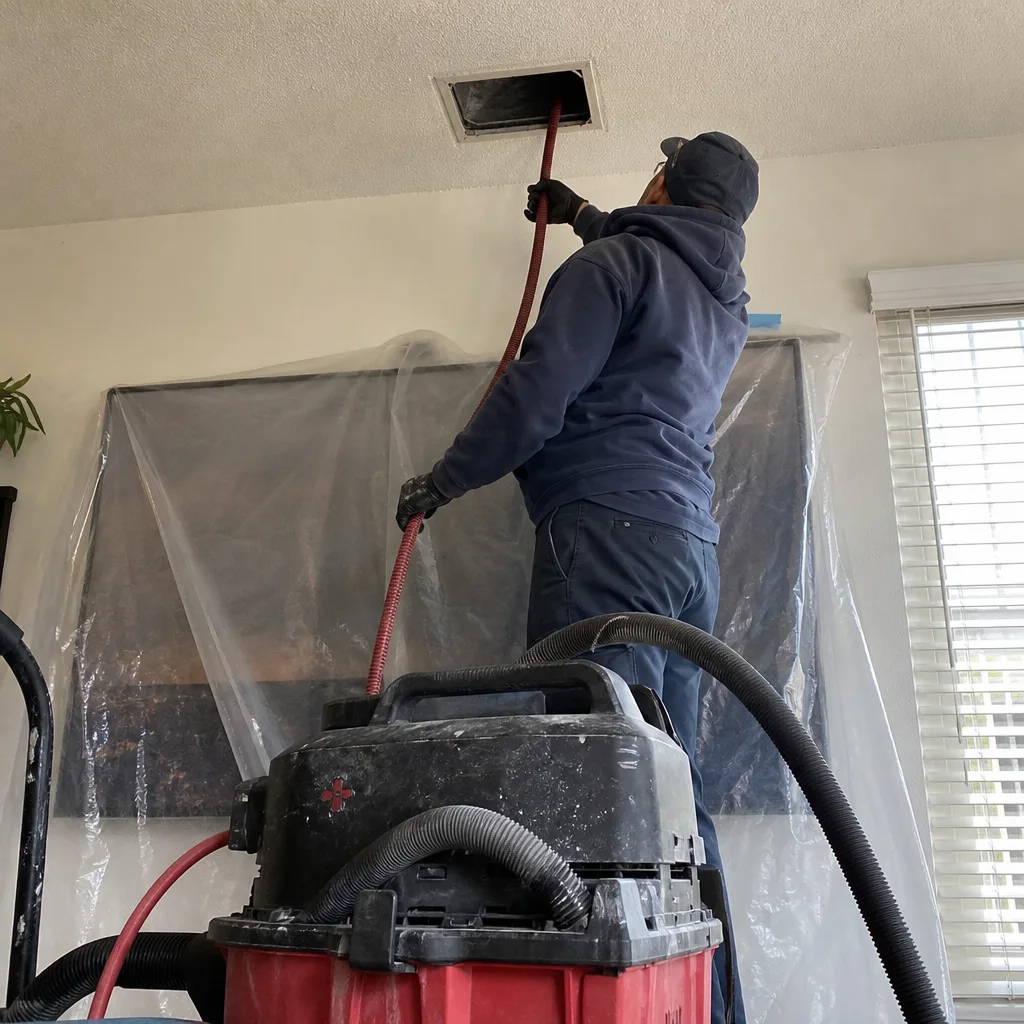 Before
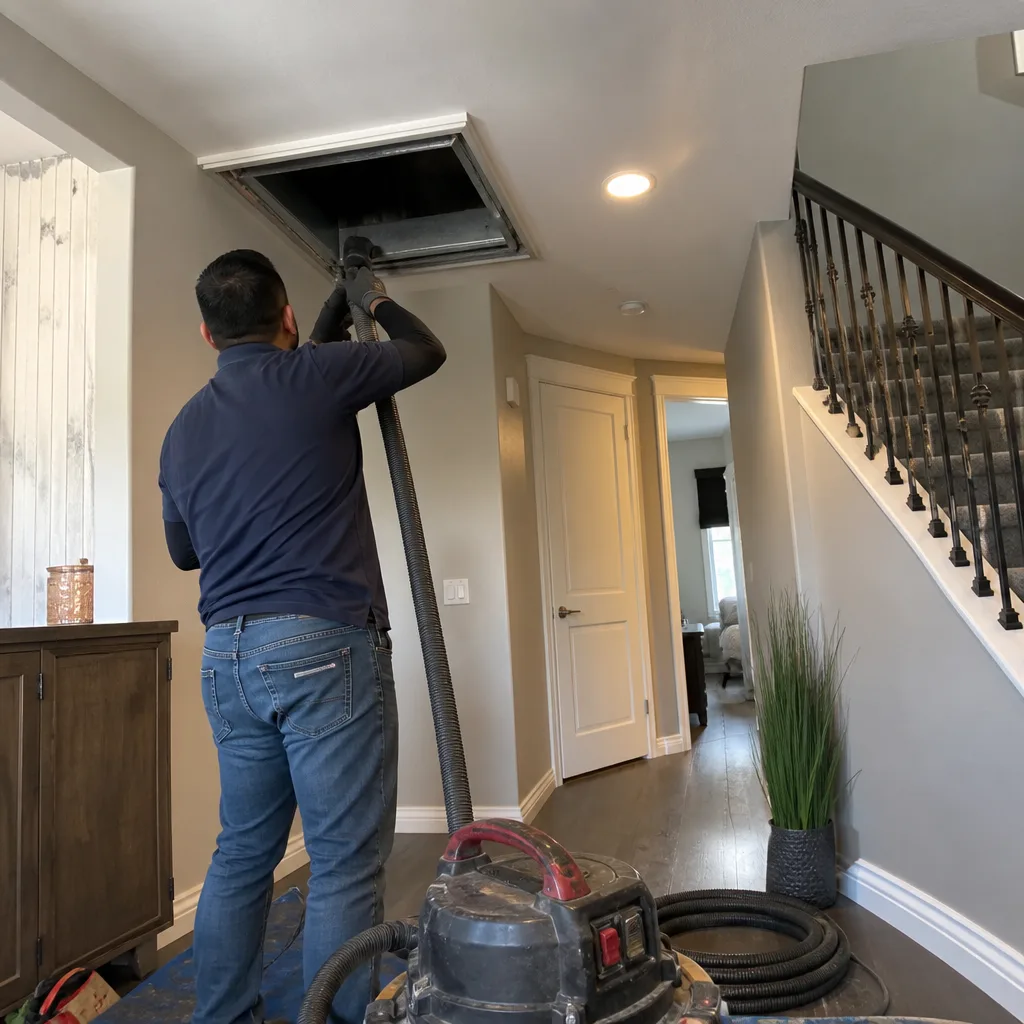 After
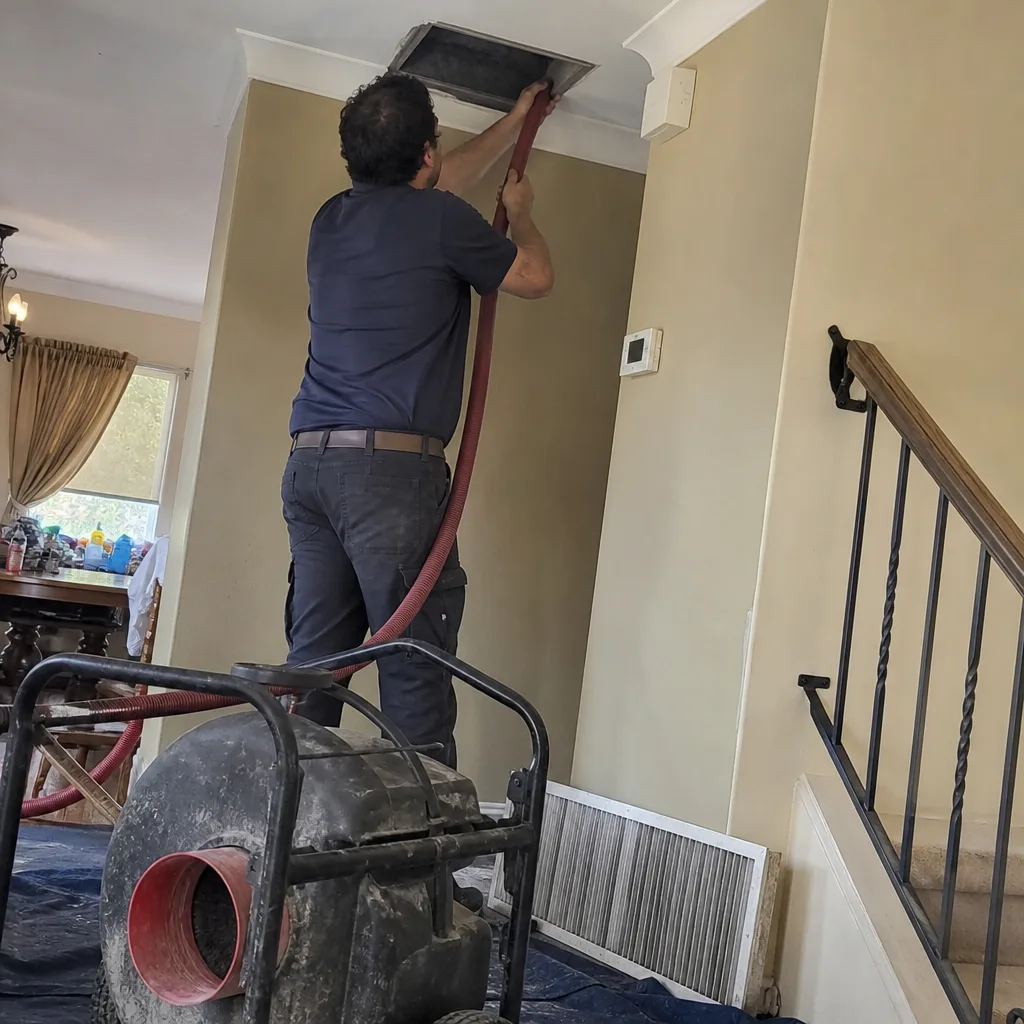 Before
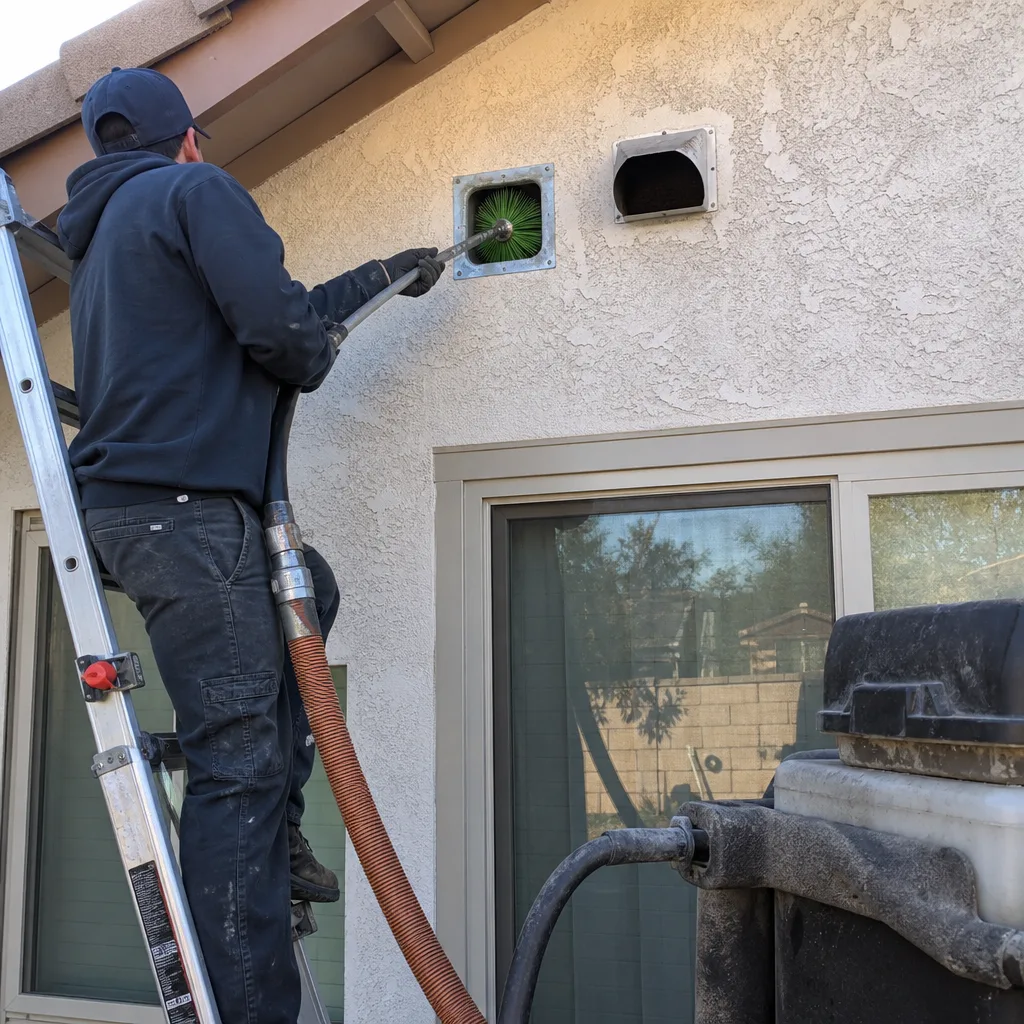 After
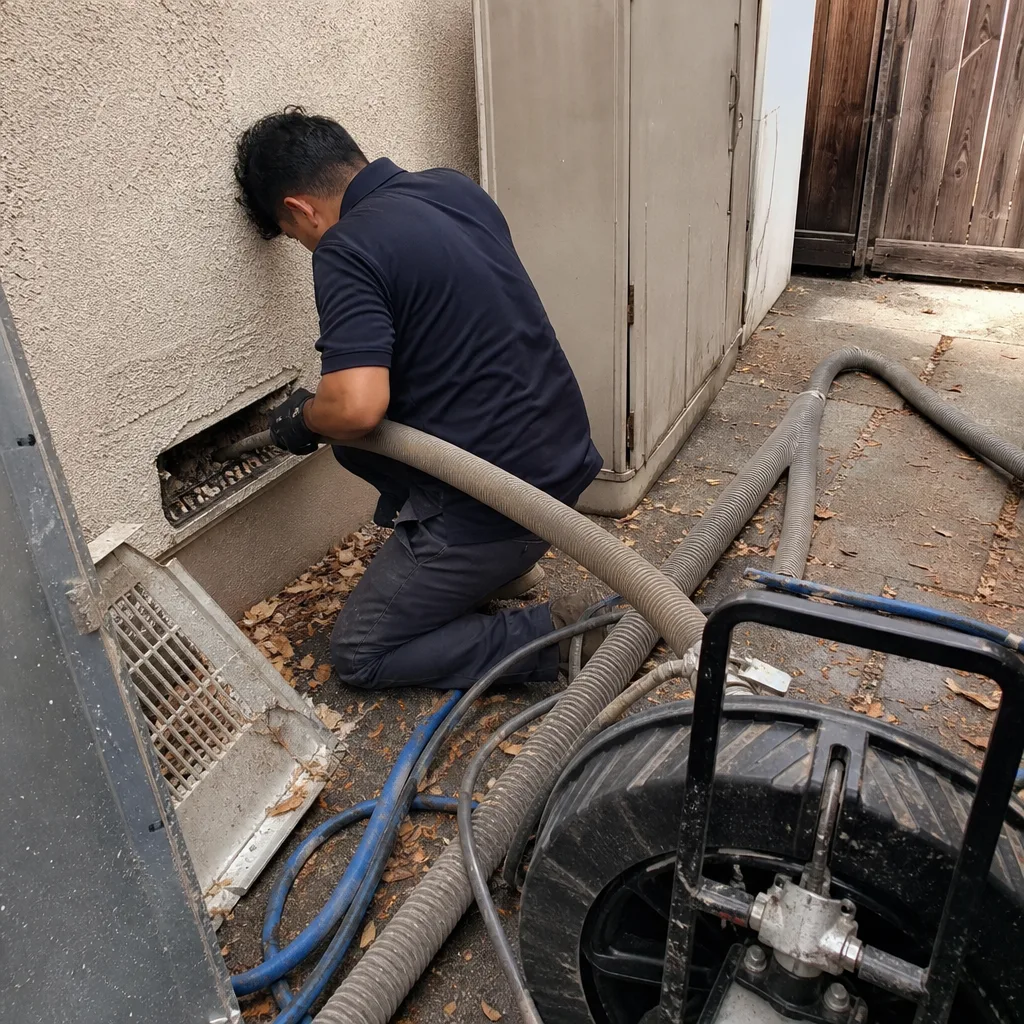 Before
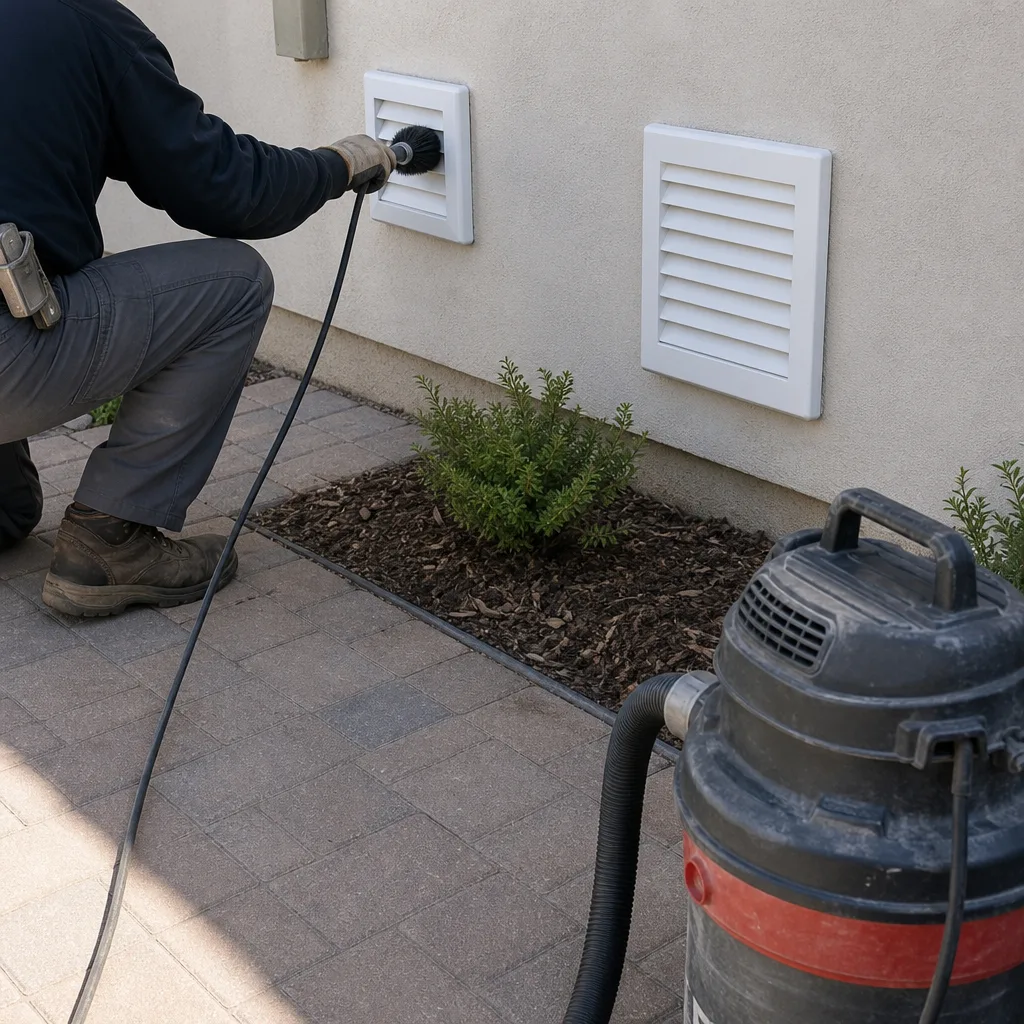 After
When to Call a Professional
Call a professional when you remove a register, point a light inside, and see what looks like a gray carpet lining the duct walls. Call when your inspection reveals debris that you can scrape away with a spoon, because that means it’s adhered to the surface and will not come out with a consumer vacuum. Call when you’re dealing with an older Rancho Bernardo home that has never had its ducts opened, because those houses have often been accumulating debris for 40 years. For help finding the right company, read our guide on How to Hire an Air Duct Cleaning Contractor in Rancho Bernardo: A Step-by-Step Guide. Call when any home’s duct system shows rodent activity, because that requires not just cleaning but sanitization and sealing of entry points. And call when you’ve already attempted some DIY work and need a repair, not just a cleaning. Golden Air Duct offers free estimates in Rancho Bernardo – call (844) 798-0150 and we’ll schedule a time to look.
Frequently Asked Questions
DIY air duct cleaning is worth it for the register-level maintenance tasks: washing vent covers, swapping filters, vacuuming accessible openings. It’s not worth it for anything inside the duct runs. The equipment that can genuinely clean the interior of a duct system starts with professional rotary brush systems and high-CFM negative pressure, and that’s not something a homeowner rents or buys. If your inspection reveals debris inside the ducts, professional cleaning is the only effective option. Call (844) 798-0150 and we’ll walk you through what we’re seeing and what it costs.
Professional whole-home air duct cleaning in Rancho Bernardo typically runs $450 to $750 for an average 2,000 to 3,000 square foot home, including the trunk line, branch ducts, and return side. Homes with more duct runs or contamination requiring additional sanitization will run higher. The range reflects the actual cost of running professional equipment with a trained crew, not a teaser figure that gets multiplied once the van pulls up. For an exact quote on your system, call (844) 798-0150 – estimates are free.
No. A shop vac generates 80 to 120 CFM of airflow, which is roughly 1/15th to 1/40th the volume of a professional truck-mount system. It can remove loose debris from the first few inches of a register opening, but it cannot break the mechanical bond between compacted debris and the duct wall surface. What typically happens is the shop vac pulls some loose dust and blows the rest into your living space through its unfiltered exhaust. The tool is wrong for the job, and that’s not a skill issue.
In Rancho Bernardo, every 3 to 5 years is a reasonable schedule for most homes, assuming normal occupancy and regular filter changes. See our Seasonal Air Duct Cleaning Care for Rancho Bernardo: Year-Round Homeowner’s Guide for details on timing. Homes with pets that shed, homes that have had recent construction or renovation, homes with medically sensitive occupants, and homes in high wind exposure areas on the western edge of Rancho Bernardo may need more frequent service. The honest test is not a calendar: it’s what the inspection shows. If the duct walls show accumulation that you can scrape with a spoon, it’s time regardless of how many years it’s been. For a professional assessment in Rancho Bernardo, call (844) 798-0150.
The signs include: visible dust accumulation around registers despite regular filter changes, rooms that accumulate dust faster than others, any musty or stale odor when the system first turns on, visible debris in the duct opening when you remove a register, rodent droppings or nesting material in the duct or around registers, and consistently dirty filters that load up within weeks rather than months. Any one of these signs warrants a closer look. Several together means you should schedule an inspection. Call (844) 798-0150 and we’ll help you figure out whether cleaning is the answer.
Some lower quotes in the Rancho Bernardo and broader San Diego market come from companies that use consumer-grade equipment (shop vac-level suction), don’t seal the duct system during cleaning, skip the camera inspection, and don’t clean the return side or trunk line. You pay less, and you don’t get a cleaned system. Other low quotes are bait pricing: a teaser figure that multiplies into a much larger invoice once the crew arrives and “discovers” additional work. We quote one flat price for the complete system, agreed before work starts, and that’s the price you pay. For an honest number on your home, call (844) 798-0150.
The Bottom Line
The DIY vs. professional duct cleaning decision in Rancho Bernardo comes down to a simple mechanical truth: the equipment that genuinely cleans the inside of a duct system does not come from a hardware store. DIY is appropriate for register maintenance, filter discipline, and inspection. Professional equipment – HEPA-filtered negative pressure with rotary brush agitation and containment – is required for the actual extraction of years of compacted debris from the duct walls. Trying to bridge that gap with consumer tools risks damaging older Rancho Bernardo duct systems and turning a $500 cleaning into a $2,000 repair. Do the inspection. Look inside. Then make the call based on what you actually find.
Written by the team at Golden Air Duct, serving Rancho Bernardo since 2013.